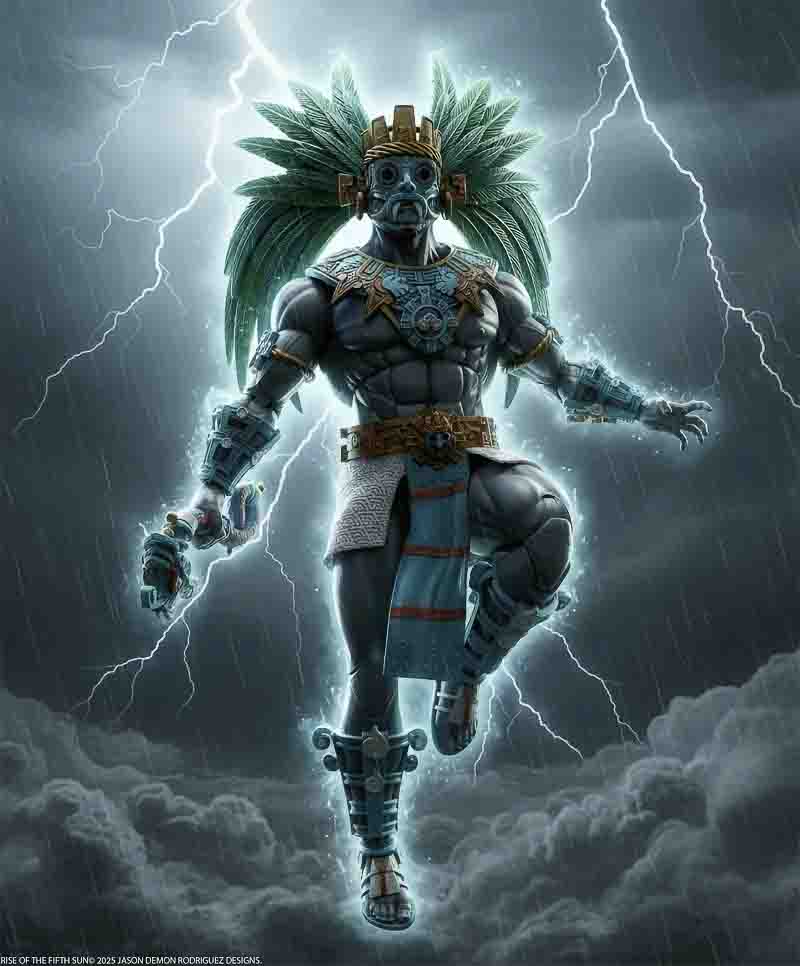
Tlaloc


Tlaloc
The Lord of Rain, Water, and Storms
Tlaloc was one of the most important deities in Mexica mythology, considered the king of atmospheric phenomena and the spirit of the mountains. His worship was deeply associated with water in all its forms: life-giving rain, lightning, floods, and ice.
His name comes from the Nahuatl Tlaloctli, meaning “nectar of the Earth.” This nectar was interpreted as the “wine” that intoxicated the earth so it could produce lush vegetation.
Family and Residence
Tlaloc was the husband of Chalchiuhtlicue, the goddess associated with the waters of terrestrial bodies (rivers, lakes, and seas), as well as the protector of sailors. While Tlaloc was directly responsible for agriculture through rain, his wife protected maritime journeys.
His dwelling was Tlalocan, a delightful paradise located in the first heaven of the Mexica cosmos. Tlalocan was conceived as a realm of abundance and eternal spring, where all kinds of fruit trees, corn, squash, tomatoes, chiles, and many other plants flourished.
Powers and Attributes
The dominion of Tlaloc encompassed everything related to the life and destruction brought by water.
Control of Rain and Storms: His essential power was the ability to send beneficial rains to fertilize the fields, but also to unleash destructive storms when expressing his fury.
Atmospheric Dominion: Lightning and thunder were attributed to him. The Mexica believed thunder to be the roar of Tlaloc. Besides rain, he could provoke hail and even earthquakes, showing his most fearsome aspect.
Agricultural Fertility: His intervention was vital, since water was seen as a purifying and life-giving element that ensured abundant harvests.
Cosmic Creation: He actively participated in the myth of the “Five Suns” (the eras of humanity), being the god who originated the Third Sun.
The Army of Helpers: He was accompanied by the tlalocas (his children), who were the clouds in charge of spreading the rain across the sky.
Tláloc
El Señor del la lluvia, el agua y la tormenta
Tláloc fue una de las deidades más importantes de la mitología mexica, considerado el rey de los fenómenos atmosféricos y el espíritu de las montañas. Su culto estaba profundamente asociado al agua en todas sus manifestaciones: la lluvia fertilizadora, los relámpagos, las inundaciones y el hielo.
Su nombre proviene del náhuatl Tlaloctli, que significa “néctar de la Tierra”. Este néctar se interpretaba como el “vino” que embriagaba a la tierra para que esta produjera una exuberante vegetación.
Familia y Residencia
Tláloc era el esposo de Chalchiuhtlicue, la diosa asociada al agua de los cuerpos terrestres (ríos, lagos y mares), además de ser protectora de los navegantes. Mientras Tláloc se encargaba directamente de la agricultura a través de la lluvia, su esposa protegía los viajes marítimos.
Su morada era el Tlalocan, un enclave placentero ubicado en el primer cielo de la cosmología mexica. El Tlalocan se concebía como un paraíso de abundancia y eterna primavera, donde crecían toda clase de árboles frutales, maíz, calabaza, tomates, chiles y otras especies vegetales.
Poderes y Atributos
El dominio de Tláloc abarcaba todo lo relacionado con la vida y la destrucción que traía el agua.
Control de la Lluvia y Tormentas: Su poder esencial era la capacidad de enviar lluvias benéficas para fertilizar los campos, pero también de desatar tormentas destructivas cuando manifestaba su furia.
Dominio Atmosférico: Se le atribuía el relámpago y el trueno. Los mexicas creían que los truenos eran los rugidos de Tláloc. Además de la lluvia, podía provocar granizo y hasta movimientos telúricos (terremotos), mostrando su faceta más temible.
Fertilidad Agrícola: Su intervención era crucial, pues el agua era vista como un elemento purificador y vital que garantizaba la abundancia de las cosechas.
Creación Cósmica: Participó activamente en el mito de los “Cinco Soles” (las eras de la humanidad), siendo el dios que dio origen al Tercer Sol.
El Ejército de Ayudantes: Contaba con los tlalocas (sus hijos), que eran las nubes, encargadas de esparcir la lluvia por el cielo.